



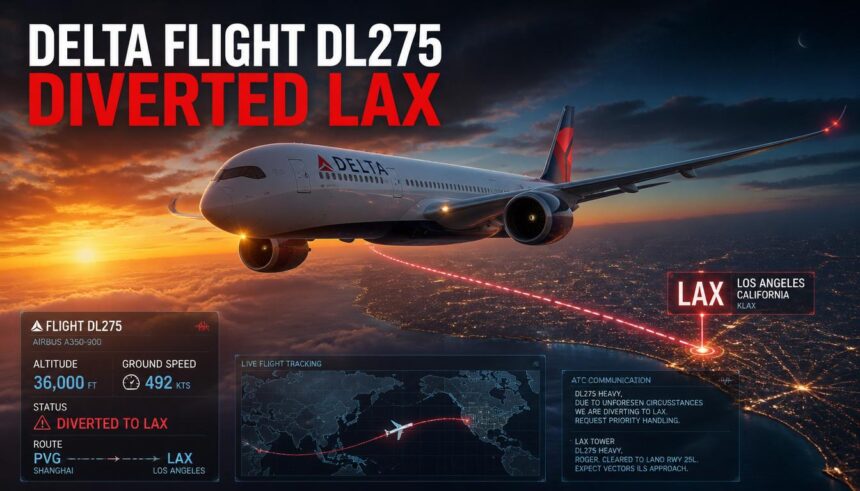
The Delta Flight DL275 diverted LAX incident gained widespread attention because of its unusual mid-ocean diversion and the technical nature of the problem involved. The flight, operating a long-haul transpacific route, experienced a serious engine-related issue while cruising at high altitude over the North Pacific Ocean. This situation immediately placed the aircraft in a category where safety decisions had to be made within minutes, balancing operational risk and passenger safety.
- Overview of the Incident
- Technical Cause: Engine Anti-Ice System Failure
- Crew Decision and Diversion Strategy
- Timeline of Events
- Passenger Experience During the Diversion
- Financial and Operational Impact
- Role of Predictive Maintenance in Modern Aviation
- Aircraft Safety and Design Strength
- Aviation Industry Lessons
What makes this case particularly important is not just the technical failure, but the way the situation was handled by the flight crew. Instead of continuing over a remote oceanic region or attempting an unsafe return, the pilots made a calculated decision to divert toward Los Angeles International Airport (LAX). This choice reflects how modern aviation prioritizes structured risk management over schedule or commercial pressure.
Overview of the Incident
The Delta Flight DL275 diverted LAX situation involved an Airbus A350 aircraft powered by Rolls-Royce Trent XWB engines. During cruise flight at approximately 38,000 feet, the crew detected a malfunction in the engine’s anti-ice system. This system plays a critical role in preventing ice formation on engine components during high-altitude flight, especially over cold regions such as the North Pacific.
Once the issue was identified, the flight could not safely continue its planned route. The distance to the destination and return airport, combined with the technical uncertainty, made diversion the safest option. LAX was selected due to its operational capacity, maintenance infrastructure, and availability of Rolls-Royce-certified technical support.
Technical Cause: Engine Anti-Ice System Failure
The anti-ice system in the Rolls-Royce Trent XWB engine is designed to ensure safe operation in extremely low temperatures. At cruising altitude, moisture can freeze rapidly and accumulate on engine surfaces, potentially disrupting airflow and reducing engine efficiency. To prevent this, the system circulates heated bleed air through critical engine sections.
When this system fails or underperforms, the aircraft does not immediately lose control, but the risk level increases significantly over time. Ice formation can lead to vibration imbalance, reduced thrust performance, and in extreme cases, partial engine instability.
In the case of DL275, the system degradation was serious enough that continuing across the Pacific Ocean was considered unsafe. Aviation protocols require that even potential risks must be treated as immediate threats when operating in remote environments with limited diversion options.
Crew Decision and Diversion Strategy
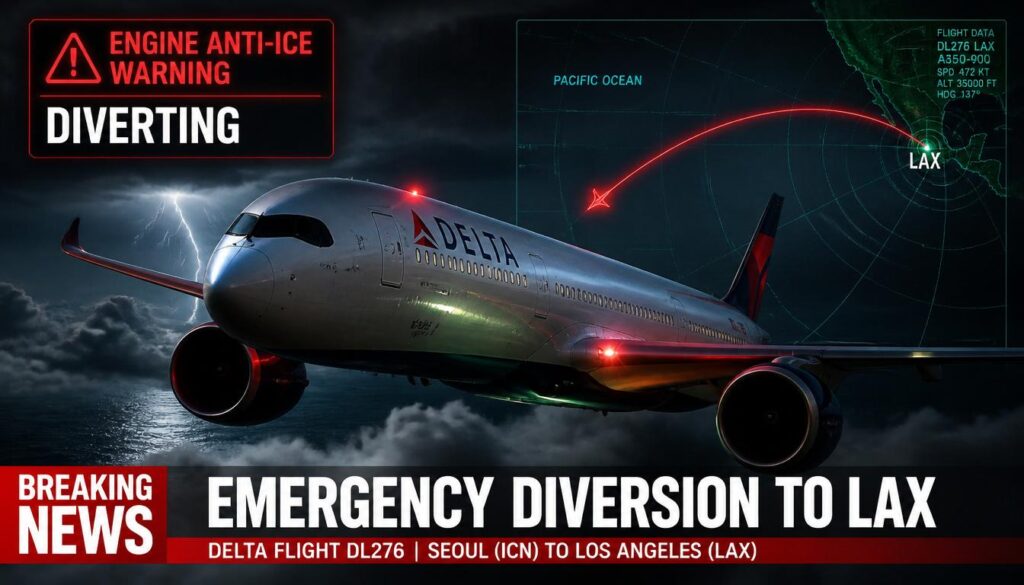
The decision to divert the aircraft to Los Angeles was not random but based on structured aviation logic. The crew evaluated multiple factors, including distance, fuel status, weather conditions, and airport capability, before selecting LAX as the diversion point.
LAX is a major Delta hub with full technical support for Airbus A350 aircraft and direct access to Rolls-Royce engineering teams. This made it the most reliable choice for both passenger safety and aircraft inspection requirements. The decision reflects standard aviation practice, where the safest available airport with maximum support capability is always prioritized.
The flight crew’s response demonstrates the importance of training and experience in handling high-pressure situations. Their ability to remain calm and follow procedure ensured a safe outcome without escalation.
Timeline of Events
| Phase | Description |
| Cruise Flight | Aircraft flying at 38,000 ft over North Pacific |
| System Alert | Anti-ice system malfunction detected |
| Risk Assessment | Crew evaluates safety and diversion options |
| Decision | LAX selected as safest diversion airport |
| Coordination | ATC provides emergency routing clearance |
| Diversion Flight | Aircraft rerouted toward Los Angeles |
| Landing | Safe landing completed at LAX |
This timeline highlights how structured and procedural aviation responses are during in-flight emergencies. Every step is coordinated between the cockpit crew and air traffic control to ensure maximum safety.
Passenger Experience During the Diversion
For passengers onboard, a diversion like Delta Flight DL275 diverted LAX can initially feel unexpected. Most passengers are not aware of technical details during flight, so the first indication usually comes through announcements from the cockpit or cabin crew.
In such situations, passengers typically experience a mixture of confusion and reassurance. However, well-trained cabin crews play a critical role in maintaining calm by clearly explaining the situation without causing panic. As the flight continues toward the diversion airport, passengers gradually understand that safety is the top priority.
Upon landing at LAX, passengers are usually informed about rebooking arrangements, accommodations, and onward travel plans. While inconvenient, such diversions are widely accepted as necessary in long-haul aviation safety.
Financial and Operational Impact
Diversions of long-haul flights, like Delta Flight DL275 to LAX, create significant operational costs for airlines. These costs are not limited to fuel consumption but extend across multiple operational areas including maintenance, passenger handling, and network disruptions.
Table 1: Estimated Cost Breakdown of Diversion
| Cost Category | Impact Level |
| Extra fuel burn | High |
| Maintenance inspection | High |
| Passenger accommodation | Moderate–High |
| Rebooking and rerouting | High |
| Landing and handling fees | Moderate |
| Network disruption | Significant |
Beyond direct costs, airlines also face indirect impacts, including schedule disruptions, crew rotation changes, and aircraft repositioning delays across their global network.
Role of Predictive Maintenance in Modern Aviation
Modern aviation increasingly relies on predictive maintenance systems powered by artificial intelligence and machine learning. These systems continuously analyze aircraft sensor data to detect early warning signs of potential system failure.
In the context of Delta Flight DL275 diverted LAX, such systems could potentially identify irregular patterns in engine performance before the issue escalates. Data such as vibration changes, temperature fluctuations, and airflow inconsistencies are monitored in real time.
Table 2: Predictive Maintenance vs Traditional Maintenance
| Maintenance Type | Detection Timing | Risk Level | Efficiency |
| Reactive | After failure | High | Low |
| Scheduled | Fixed intervals | Medium | Moderate |
| Predictive | Early detection | Low | High |
Although predictive maintenance significantly improves safety and efficiency, it does not replace pilot decision-making or onboard safety systems. Instead, it works as an additional safety layer.
Aircraft Safety and Design Strength
The Airbus A350 is designed with advanced redundancy systems that ensure continued safe operation even in the event of partial system failure. In this case, despite the anti-ice system issue, the aircraft remained fully controllable and structurally stable.
Twin-engine long-haul aircraft like the A350 are certified under ETOPS regulations, which allow them to fly extended distances over oceanic regions. These certifications require strict safety standards and multiple backup systems to ensure that even in abnormal situations, safe diversion remains possible.
This design philosophy ensures that modern aircraft are capable of handling complex in-flight scenarios without compromising passenger safety.
Aviation Industry Lessons
The Delta Flight DL275 diverted LAX incident reinforces several key aviation safety principles that are widely accepted across the industry. One of the most important lessons is that early diversion decisions are a core part of safety management, not indicators of system failure.
Another important lesson is the role of human decision-making in aviation safety. Even with advanced automation and monitoring systems, final decisions are made by trained pilots who assess risk in real time. This combination of technology and human judgment is what makes modern aviation one of the safest modes of transportation.
The incident also highlights the increasing importance of predictive maintenance systems, which are becoming essential tools for reducing unexpected technical disruptions in long-haul operations.
Conclusion
The Delta Flight DL275 diverted LAX incident demonstrates how modern aviation safety systems, crew training, and aircraft design work together to manage unexpected technical issues effectively. While the engine anti-ice system malfunction was a serious concern, the structured response ensured that the aircraft was safely diverted and landed without incident.
Rather than being seen as a failure, this event should be viewed as an example of aviation safety working exactly as intended. The crew made a timely decision, the aircraft performed reliably under pressure, and ground support systems at LAX ensured a smooth landing and recovery process. Ultimately, the incident reinforces the strength and reliability of modern aviation safety standards.
FAQs
Why was Delta Flight DL275 diverted to LAX?
Delta Flight DL275 was diverted to Los Angeles International Airport due to a malfunction in the engine anti-ice system during cruise flight over the North Pacific. The crew chose LAX because it is a major Delta hub with full technical and maintenance support for the Airbus A350.
Was Delta Flight DL275 in danger during the flight?
The aircraft was not in immediate danger of crashing, but the anti-ice system failure increased operational risk, especially over remote oceanic areas. For safety reasons, the crew decided to divert before the situation could potentially worsen.
What is the function of the engine anti-ice system?
The engine anti-ice system prevents ice formation on critical engine parts by using heated air from the engine compressor. This ensures safe airflow and stable engine performance during high-altitude flight in freezing conditions.
Did passengers land safely after the diversion?
Yes, all passengers and crew landed safely at Los Angeles International Airport. After landing, the airline arranged assistance, including rebooking and onward travel support for affected passengers.
Could this type of incident be prevented in the future?
Modern predictive maintenance systems using AI and real-time engine monitoring may help detect early signs of system degradation. However, aviation still relies on redundancy and pilot decision-making to ensure maximum safety in all conditions.