netpub60@gmail.com
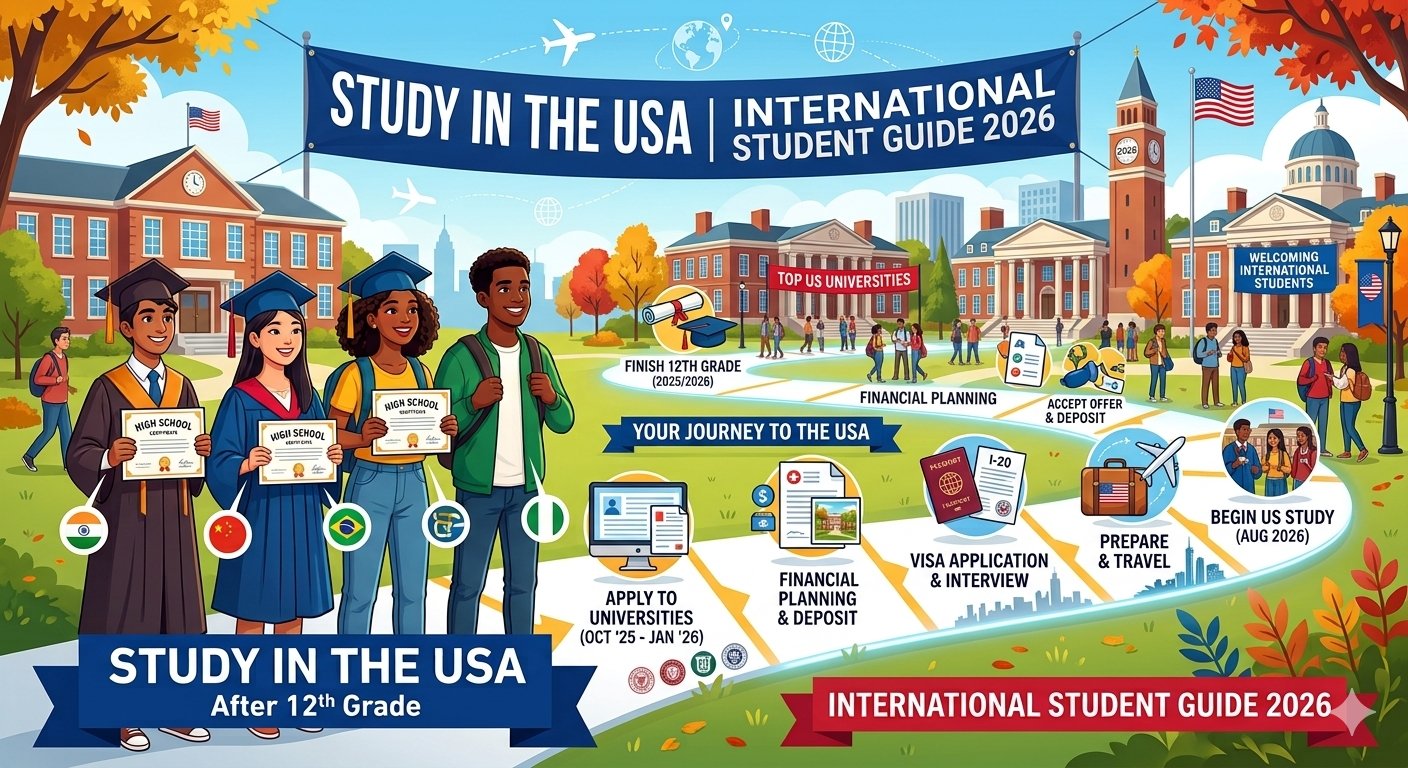
Study in the USA After 12th Grade: International Student Guide 2026
International Student Guide 2026: How to Study in the USA After 12th Grade
Studying in the United States after completing 12th grade is a goal for thousands of international students every year. American universities offer a wide variety of undergraduate programs, modern facilities, research opportunities, and multicultural campus communities. However, applying to a U.S. university can seem complicated when you are dealing with admissions, English-language requirements, standardized tests, finances, visas, and accommodation at the same time.
For students planning to begin university in 2026, understanding the process early can make the journey much easier. The right preparation can also help students identify universities that match their academic interests, financial situation, and long-term career plans.
This guide explains the major steps international students should understand before applying to undergraduate universities in the USA after 12th grade.
Why Study in the USA After 12th Grade?
The United States has one of the world’s largest and most diverse higher-education systems. Students can choose from universities ranging from large public institutions to smaller private colleges.
One important advantage is academic flexibility. At many American universities, students can explore different subjects before deciding on a final major. For example, a student interested in technology could combine computer science with business, mathematics, economics, or another discipline.
Wide Range of Programs
International students can find undergraduate programs in almost every academic field, including:
- Computer science and artificial intelligence
- Engineering
- Business and finance
- Medicine and life sciences
- Data science
- Psychology
- Media and communications
- Architecture
- Environmental sciences
- Economics
- Social sciences
This variety allows students to search beyond university rankings and focus on programs that genuinely match their interests.
What Are the Basic Requirements?
Admission requirements vary by university and program, so students should always check the official admissions page of each institution.
Generally, an international undergraduate applicant may need several important documents.
Academic Transcripts
Students normally need to provide their secondary-school or 12th-grade academic records. Universities may evaluate grades, subjects studied, academic progression, and the overall curriculum.
Strong performance in subjects related to the intended major can be particularly useful. For example, an engineering applicant may need a solid background in mathematics and science.
English-Language Proficiency
Students whose previous education was not conducted in English may need to demonstrate English proficiency.
Universities may accept tests such as:
- IELTS
- TOEFL
- PTE Academic
- Duolingo English Test
The accepted tests and minimum scores differ between universities, so applicants should verify requirements before booking an examination.
SAT or ACT
Standardized testing policies vary significantly among U.S. universities. Some institutions require SAT or ACT scores, while others are test-optional or have different testing policies.
Because policies can change, students applying for 2026 entry should check the current requirements directly with each university.
How Much Does It Cost to Study in the USA?
Cost is one of the most important considerations for international students.
The total annual budget generally includes tuition, accommodation, food, transportation, health insurance, books, and personal expenses.
Tuition Fees
Tuition varies substantially depending on the institution and program. Public universities may have different tuition rates for international students, while private universities generally use their own fee structures.
Students should look at the university’s estimated cost of attendance, rather than considering tuition alone.
Living Expenses
Living costs can differ dramatically between locations.
For example, studying in a major metropolitan area such as New York City or Los Angeles can involve higher housing costs than studying in a smaller college town.
Before applying, students should create a realistic annual budget covering:
- Housing
- Food
- Transportation
- Health insurance
- Books and supplies
- Mobile and internet services
- Personal expenses
Scholarships for International Students
Scholarships can significantly reduce the financial burden of studying in America.
International students should investigate three major categories of funding.
Merit-Based Scholarships
These scholarships are generally connected to academic achievement, leadership, extracurricular activities, or other accomplishments.
Some universities automatically consider applicants for certain awards, while others require a separate scholarship application.
Need-Based Financial Aid
Some universities provide financial assistance based on a student’s demonstrated financial need. Policies for international students differ considerably between institutions.
Applicants should carefully read the university’s financial-aid requirements and understand whether international students are eligible.
External Scholarships
Students can also search for scholarships offered by governments, foundations, nonprofit organizations, and other institutions in their home countries.
Starting the scholarship search early is important because deadlines can occur months before university enrollment.
How to Choose the Right U.S. University
Choosing a university should involve more than searching for the highest-ranked institution.
A better strategy is to create a shortlist based on several factors.
Consider Your Major
Start with your intended field of study. A university that is excellent overall may not necessarily provide the program, specialization, laboratory facilities, or faculty expertise you need.
Research the actual department rather than relying solely on the university’s overall ranking.
Compare Costs
Two universities with similar academic reputations can have very different total costs.
Compare tuition, housing, scholarships, health insurance, transportation, and other expenses before making a decision.
Research Location
Location can influence your student experience considerably.
Think about climate, transportation, housing availability, city size, internship opportunities, and proximity to companies related to your intended career.
Look at Career Services
For many international students, career support is an important consideration.
Investigate whether the university offers internships, career counseling, employer events, alumni networking, research opportunities, and other professional development services.
Application Process for International Students
The U.S. application process can involve several stages.
Step 1: Build a University Shortlist
Begin by identifying universities that match your academic profile, budget, intended major, and preferred location.
A balanced shortlist can include institutions with different admission requirements and costs.
Step 2: Check Deadlines
U.S. universities may have different deadlines for Early Decision, Early Action, Regular Decision, and other application rounds.
Some programs also have separate deadlines for scholarships or financial aid.
Never assume that all universities follow the same calendar.
Step 3: Prepare Your Documents
Common application materials can include:
- Academic transcripts
- English-language test results
- SAT or ACT scores where applicable
- Personal essay
- Letters of recommendation
- Extracurricular information
- Passport information
- Financial documentation
Individual universities may request additional materials.
Step 4: Write a Strong Personal Essay
The personal essay gives applicants an opportunity to explain their interests, experiences, goals, and motivation.
A strong essay should sound personal rather than like a collection of impressive words. Students should explain what they have learned from their experiences and why their chosen academic path matters to them.
Step 5: Submit Applications
Depending on the university, applications may be submitted through platforms such as the Common Application or through the university’s own application system.
Students should carefully review every section before submitting an application.
What Happens After Admission?
Receiving an admission offer is an important milestone, but international students still have several steps to complete.
Accept Your University Offer
If you receive multiple offers, compare the total cost, financial aid, academic program, location, and other practical factors before making your choice.
Once you select a university, follow its instructions for confirming enrollment.
Obtain Your I-20
International students admitted to a U.S. university generally need the appropriate immigration documentation from their institution before applying for a student visa.
Students should carefully follow instructions provided by their university’s international student office.
Apply for a Student Visa
Students attending an academic program in the United States generally apply for an F-1 student visa.
The process involves several stages, including completing the required forms, paying applicable fees, and attending a visa interview when required.
Applicants should use official U.S. government and university resources for the latest visa requirements.
How Can International Students Prepare for Life in America?
Moving to another country is more than an academic transition. Students may need time to adjust to a different educational system, culture, climate, food, transportation system, and social environment.
Understand the Academic Culture
American universities may place significant emphasis on class participation, presentations, group projects, independent research, and continuous assessment.
Students should become comfortable asking professors questions and seeking academic support when necessary.
Plan Accommodation Early
Housing can be an important issue, particularly in large cities.
Students should investigate university housing, private accommodation, meal plans, transportation, and lease requirements before arriving.
Build a Support Network
International student offices, academic advisors, student organizations, cultural societies, and campus clubs can help new students establish connections.
Joining activities related to academic interests or hobbies can also make it easier to meet people.
Final Checklist for Students Planning to Study in the USA
Before submitting applications, international students should make sure they have considered:
- Intended major and career direction
- University admission requirements
- English-language requirements
- SAT/ACT policies where applicable
- Application deadlines
- Tuition and living expenses
- Scholarship opportunities
- Required financial documents
- Passport validity
- Student visa requirements
- Housing options
- Health insurance
- Travel arrangements
Final Thoughts
Studying in the USA after 12th grade can provide international students with access to a diverse academic environment and a wide selection of undergraduate programs. However, the application process requires careful planning.
The most important step is not simply choosing a famous university. Students should look for a university that fits their academic goals, financial resources, preferred environment, and future career plans.
For students targeting 2026 entry, beginning preparation early can provide more time to research universities, complete English-language testing, prepare applications, search for scholarships, and organize visa documentation.